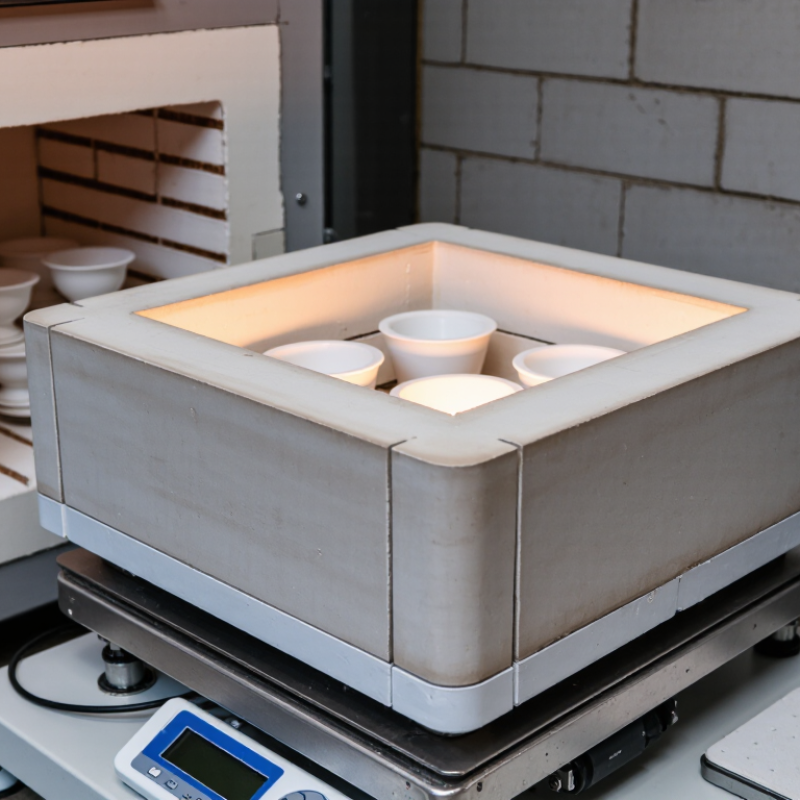
| Material | Cordierite composition and grade | Select a documented cordierite or cordierite-based refractory grade suitable for the intended firing atmosphere and maximum temperature. | Request a material certificate identifying chemical composition, firing temperature, maximum service temperature, and applicable test results. | Do not mix saggars with substantially different thermal-expansion behavior in the same firing cycle unless the process has been validated. |
| Thermal Expansion | Coefficient of thermal expansion | Prefer a low and stable value, commonly about 1.5–3.0 × 10⁻⁶/K for cordierite-based ceramics, depending on grade and test direction. | Review the supplier’s dilatometry report and test temperature range; compare results with the kiln heating and cooling profile. | A low expansion coefficient helps reduce thermal-shock stress, but it does not eliminate damage caused by rapid temperature changes or uneven loading. |
| Service Temperature | Maximum continuous operating temperature | Choose a rated service temperature above the actual peak kiln temperature. Many cordierite-based products are used in the approximate range of 1,200–1,400 °C, depending on grade and atmosphere. | Check the technical data sheet for continuous-use and intermittent-use limits rather than relying only on the material name. | Keep the operating temperature below the stated limit and consider the effects of load weight, atmosphere, dwell time, and repeated cycles. |
| Dimensions | Length, width, height, wall thickness, and flatness | Specify dimensions according to the kiln shelf, product footprint, stacking arrangement, and required gas circulation. Use consistent wall thickness to reduce uneven heating. | Measure representative samples with calibrated gauges. Check overall dimensions, diagonal difference, wall thickness, base flatness, and corner squareness. | Leave clearance between the saggar and kiln walls or heating elements. Avoid forcing a distorted saggar into a tight kiln space. |
| Dimensional Tolerance | Manufacturing consistency | Set tolerances according to the kiln and stacking design. A practical internal control may use tighter tolerances for interlocking or automated handling than for loose single-piece loading. | Define an approved drawing with measured nominal dimensions and allowable deviation before mass purchasing. | Use the same orientation during stacking when dimensional variation could affect airflow, product contact, or load stability. |
| Bulk Density | Density uniformity | Use the supplier’s grade-specific value as the reference. Uniform density is more important than selecting the highest density alone because excessive density can increase thermal mass. | Evaluate bulk density using a recognized ceramic or refractory test procedure, such as ASTM C20 where applicable. | Reject pieces with large internal voids, soft zones, or abnormal weight differences that may indicate nonuniform forming or firing. |
| Porosity and Absorption | Apparent porosity and water absorption | Use consistent, grade-specific limits. Open porosity affects gas penetration, contamination behavior, mechanical strength, and moisture sensitivity. | Test representative samples using a suitable apparent-porosity and water-absorption method, such as ASTM C20 when applicable. | Store saggars in a dry, covered area. Dry damp pieces completely before high-temperature use to reduce vapor-related cracking. |
| Mechanical Integrity | Cracks, chips, warpage, and edge strength | Surfaces should be free from through-cracks, open laminations, severe edge chipping, and deformation that affects safe stacking. | Perform 100% visual inspection. Use a light tap comparison only as a screening method; confirm questionable pieces with dimensional or laboratory testing. | Handle with two hands or suitable lifting tools. Do not drag saggars across kiln shelves or place them down on one corner. |
| Thermal Shock | Resistance to repeated heating and cooling | Choose a grade validated for the actual cycle frequency, peak temperature, cooling rate, and load condition. There is no single universal thermal-shock limit for every saggar design. | Request cycle-test data using a method representative of the production process. Record the number of cycles until cracking, warpage, or unacceptable strength loss. | Use gradual heating and cooling whenever the process permits. Avoid placing a hot saggar on a cold metal surface or exposing it to drafts. |
| Surface Condition | Work surface, glaze, coating, and contamination | The inner surface should be compatible with the fired product and any powder, setter, glaze, or protective coating used in the process. | Inspect for loose particles, coating flaking, embedded foreign matter, and rough areas that could mark the product. | Remove loose residue with a soft brush or approved vacuum method. Avoid aggressive scraping that damages the ceramic surface. |
| Load Design | Product mass and load distribution | Calculate the total product and setter mass per saggar. Distribute the load evenly and keep the center of gravity low and centered. | Record the maximum approved load per saggar and confirm it through a trial firing and post-cycle inspection. | Do not exceed the validated load. Uneven loads can cause local stress, sagging, cracking, and poor gas circulation. |
| Stacking | Vertical alignment and airflow | Stack only stable, dimensionally compatible pieces. Maintain designed gaps for heat transfer and atmosphere circulation. | Use a stacking checklist covering alignment, gap size, base support, and maximum stack height. | Do not use cracked or badly warped saggars as load-bearing pieces. Rotate orientation only when the process documentation permits it. |
| Atmosphere Compatibility | Oxidizing, neutral, or reducing atmosphere | Confirm compatibility with the kiln atmosphere, volatile compounds, fluxes, and reaction products generated during firing. | Review chemical compatibility data and inspect for discoloration, reaction layers, softening, or accelerated erosion after trial cycles. | Separate saggars used for chemically incompatible materials and clearly identify them to prevent cross-contamination. |
| Incoming Quality Control | Sampling and acceptance records | Define an inspection plan covering appearance, dimensions, weight, flatness, and material documentation before production release. | Assign lot numbers and retain inspection records, certificates, sample measurements, and photographs of nonconforming pieces. | Quarantine rejected pieces. Do not place unverified saggars directly into a production kiln. |
| Routine Maintenance | Cleaning, inspection, and repair decision | Inspect before and after every firing cycle for cracks, warpage, residue buildup, edge damage, and changes in surface condition. | Use a simple condition rating such as: A = production-ready, B = limited use after review, C = remove from service. | Minor removable residue may be cleaned; structural cracks, through-cracks, severe warpage, or unstable edges generally require retirement. |
| Service Life | Number of firing cycles | Do not use a fixed cycle count as the only replacement rule. Actual life depends on temperature, thermal gradients, atmosphere, load, handling, and cleaning. | Track cycles, failures, operating conditions, and measured defects for each lot or batch. | Establish a replacement threshold from historical failure data and remove pieces before they create product or kiln damage. |
| Storage | Moisture, impact, and stacking position | Store on a level, protected surface in a dry area. Support large saggars evenly to prevent long-term bending. | Check stored inventory periodically for moisture, impact damage, edge chipping, and unsupported spans. | Use separators where needed and avoid high stacks that could fall or place point loads on lower pieces. |
| Process Validation | Trial firing and acceptance criteria | Approve a new saggar design only after it demonstrates acceptable product quality, dimensional stability, thermal performance, and handling safety. | Compare pre- and post-firing dimensions, surface condition, weight change, product defects, and kiln-cycle results. | Revalidate after changing saggar geometry, product load, kiln program, firing atmosphere, or protective materials. |